
LANGUAGE & LITERATURE

PARS RECORDS Ⓜ️all
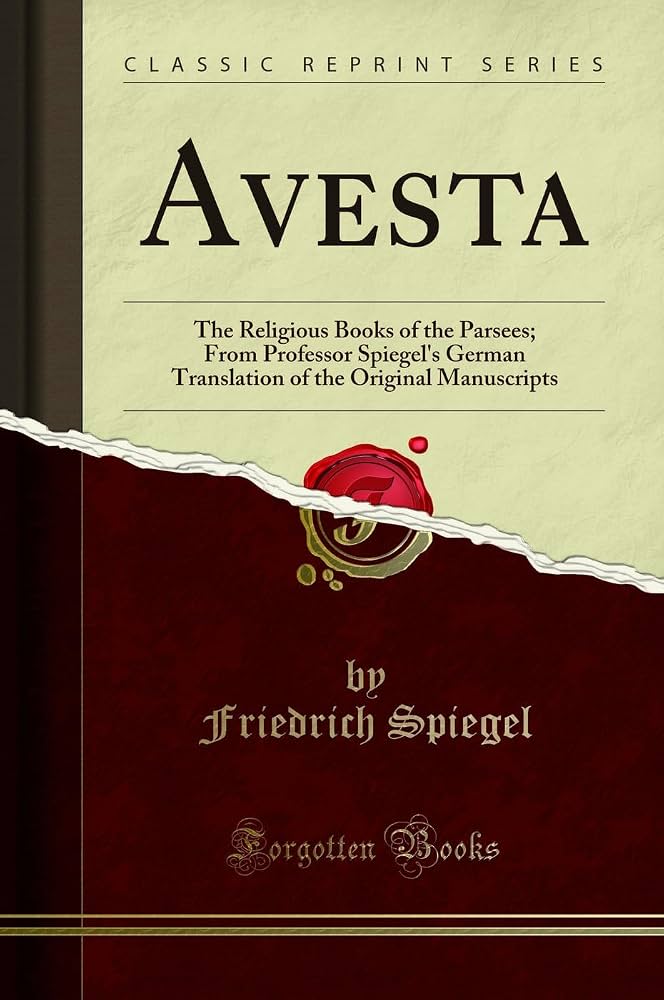
Avesta, the Religious Books of the Parsis: From Professor Spiegel’s German Translation of the Original Manuscripts refers to an important English-language presentation of the sacred literature of Zoroastrianism, based on the scholarly German translation and study of the Avesta by the German Orientalist Friedrich Spiegel (1820–1905)
The Avesta is the principal body of sacred texts preserved by the Zoroastrian community, historically known in India as the Parsis. Its surviving books contain prayers, liturgical compositions, religious laws, rituals, theological teachings, and hymns associated with the Zoroastrian tradition. Among its oldest and most significant portions are the Gathas, traditionally associated with Zarathustra (Zoroaster) himself.
Spiegel's work belongs to the nineteenth-century European scholarly effort to recover, translate, and critically study the ancient Iranian religious texts from surviving Avestan manuscripts. His German translation sought to make the difficult Avestan material accessible while placing it within the broader linguistic and historical context of ancient Iran. Such scholarship was particularly important because the Avesta had survived through a long tradition of transmission, copying, interpretation, and priestly preservation.
The phrase “from Professor Spiegel’s German translation of the original manuscripts” is therefore significant: it indicates a work derived from Spiegel's German rendering of the Avestan texts rather than a translation made independently from the original language. For readers of the nineteenth century, publications of this kind provided an important bridge between the manuscript tradition preserved by Zoroastrian communities and the growing academic study of ancient Iranian religion, language, and culture.
Today, the Avesta remains one of the central sources for understanding Zoroastrian theology, ancient Iranian religious thought, Avestan language, ritual traditions, and the intellectual heritage of pre-Islamic Iran. Spiegel's scholarship is part of the early modern academic history through which these texts became increasingly accessible to Western readers and comparative scholars.