

 |
DISCOVER AIDA'S ARTISTIC PROFILE
The Story of Esther: a Historical Examination of Its Origins, Credibility, and Connections to Ancient Iranian Traditions
The Story of Esther is a Jewish legend. However, given the social and political circumstances of the past century, it has acquired particular characteristics. The story has become an instrument for both anti-Iranian groups and antisemites.
Certain extremist groups in Israel have adopted approaches that reflect anti-Iranian sentiment. Within Iran, meanwhile, some individuals promote narratives of their own making that not only encourage antisemitism but also provide considerable material for anti-Iranian movements.
Some individuals in Iran with antisemitic views distort the Story of Esther and make inaccurate claims about the history of ancient Iran and the Achaemenid Empire. They even attribute the origins of Sizdah Bedar to this story, without considering credible historical evidence or documentation.
The Book of Esther contains numerous contradictions and cannot, under any circumstances, be regarded as a reliable historical source. The distorted accounts derived from it likewise lack any historical foundation and are presented without supporting evidence. The Story of Esther is more akin to legend and mythology than to historical fact. Even the Dead Sea Scrolls contain no trace of the Book of Esther.
This raises the possibility that the festival of Purim does not necessarily originate in Jewish tradition. One hypothesis suggests that Purim was adopted into Jewish culture from other peoples before the Story of Esther emerged and became established among the Jewish community. Some Jews during the Hellenistic period sought to establish a Jewish origin for this festival, and the Story of Esther may have taken shape as part of that process.
In this article, we attempt to examine the Story of Esther from a historical perspective, setting aside the controversy surrounding it, and to discuss its possible origins.
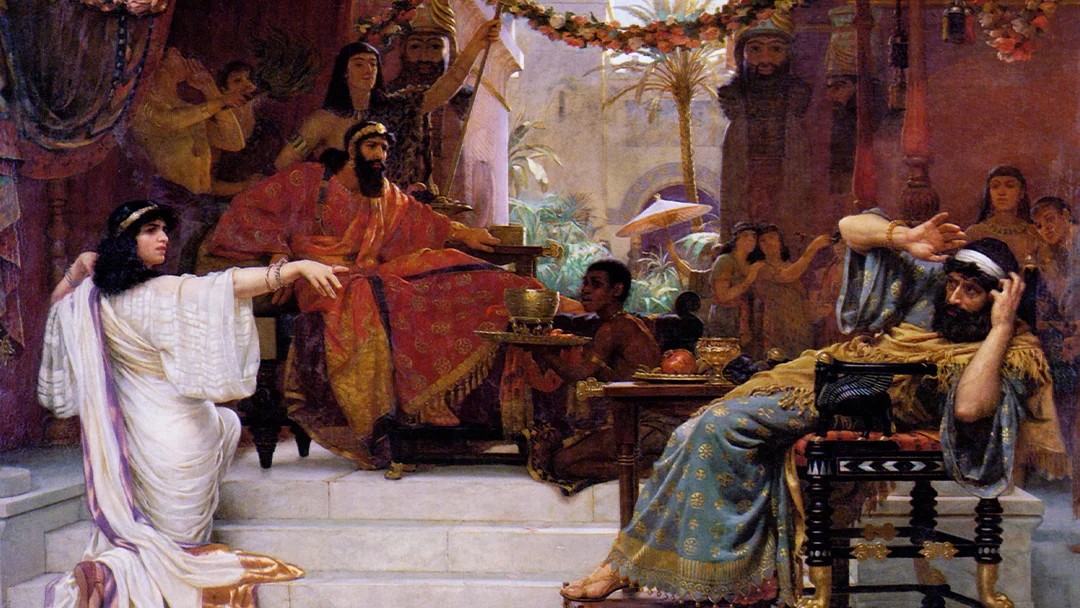
What Does the Book of Esther Say?
The Book of Esther recounts a story set during the reign of a king named Ahasuerus. Based on the narrative, its setting appears to correspond to the Achaemenid period.
The story can be summarized as follows:
In the third year of his reign, Ahasuerus holds a magnificent banquet at the palace of Susa. After the king has become merry with wine, he orders that his queen, Vashti, be brought before him wearing her royal crown so that he may display her beauty to the nobles and other guests, as she is described as a beautiful woman. However, the queen refuses to comply. The king becomes furious and, after consulting the country's nobles, removes her from her position (Esther, Chapter 1)
Ahasuerus subsequently decides to appoint representatives throughout his provinces to gather beautiful young women and bring them to the royal palace in Susa. He intends to select as his queen whichever woman pleases him most.
Among these women, the king favors a young woman named Hadassah and chooses her as queen. She later becomes known as Esther. Esther has a cousin named Mordecai, who raised her. Mordecai had already been present at the royal palace in Susa.
Esther was Jewish, but at Mordecai's request, she concealed her identity. The story also relates that Mordecai uncovered a conspiracy against the king involving two of his eunuchs (Esther, Chapter 2) This discovery subsequently leads to his promotion (Esther, Chapter 6)
One of the kingdom's prominent officials, Haman son of Hammedatha the Agagite, becomes resentful because Mordecai refuses to bow before him. He consequently develops a hatred of the Jews and, arguing that their laws differ from those of all other peoples, asks the king for permission to annihilate them (Esther, Chapter 3)
Mordecai learns of this plot and becomes deeply distressed. He asks Esther to intervene and prevent the planned destruction. Although approaching the king without permission carries the risk of death, Esther decides to put her life in danger (Esther, Chapter 4)
The king receives Esther favorably, and she invites him and Haman to two banquets (Esther, Chapter 5) At the second banquet, Esther reveals to the king that she is Jewish and that Haman intends to destroy her people (Esther, Chapter 7) Esther subsequently obtains a royal decree that saves the Jews from annihilation and results in the execution of their enemies, particularly Haman (Esther, Chapters 7 and 8)
The story goes on to claim that the Jews killed 77,000 of their adversaries and were thereby relieved of their enemies, although they did not plunder their possessions (Esther, Chapter 9)
The entire narrative is presented in the Book of Esther. Although certain details differ between some versions, the overall story remains essentially the same.
The Jewish community celebrates this day as Purim because, according to the narrative, the Jews escaped annihilation and massacred their enemies.
Summary of the Arguments Against the Historical Authenticity of the Story of Esther
Here, we briefly present several of the many arguments suggesting that the Story of Esther is little more than a legend. Each point will subsequently be examined in greater detail.
-
The Book of Esther is absent from the Dead Sea Scrolls.
-
No evidence of this story appears in historical sources or surviving archaeological records.
-
The author of the Story of Esther is unknown. The Book of Esther entered Jewish literary tradition after Alexander's conquests, since the story cannot be traced in earlier sources.
-
According to the chronology of the Story of Esther, Mordecai's age is legendary, exceeding 100 years.
-
Jews have a very limited presence in Achaemenid inscriptions and artistic representations. There are no depictions of Jews at Persepolis. Yet, according to the Story of Esther, the queen of the empire, Esther, and subsequently one of the empire's leading officials, Mordecai, were Jewish.
-
How could Jews have attained such prominent positions within a political system without leaving any representation of their community in the royal palaces?
-
According to official Achaemenid inscriptions, the Persian Empire consisted of more than twenty provinces, whereas the Book of Esther refers to 127 provinces. This suggests that its author lacked precise knowledge of the administrative structure of the Persian Empire.
-
The Book of Esther describes a banquet lasting 180 days. No Iranian festival is known to have taken place under such circumstances. This also suggests that the author was unfamiliar with Iranian cultural traditions.
-
According to the Book of Esther, the Jews killed 77,000 of their enemies. The text also suggests that Haman commanded a military force of 77,000 men and intended to use it to annihilate the Jews. This raises several questions: How could the king have been unaware of such a military organization, and how could all its members have been under Haman's command?
The Absence of the Book of Esther from the Dead Sea Scrolls
The absence of the Book of Esther from the Dead Sea Scrolls raises an important question for every researcher: Does the Story of Esther have a genuine historical foundation?
One of the most significant and fascinating archaeological discoveries of the twentieth century was the discovery of ancient scrolls in the Qumran region of Palestine, now widely known as the Dead Sea Scrolls.
In brief, these ancient scrolls contain many of the texts found in the books of the Old Testament. Perhaps the most important point for our discussion is that the Book of Esther is entirely absent from this collection!
The Author of the Book of Esther Is Unknown
The author of the Book of Esther is unknown, and even the precise date of its composition remains uncertain. Nevertheless, most researchers consider it likely that the text was compiled after the conquests of Alexander the Great, during the Hellenistic period.
The Story of Esther appears exclusively in Jewish sources. No trace of it has been found in the writings of Greek historians or in the surviving records of ancient Iran.
This is particularly noteworthy because the Book of Esther claims that the events surrounding Mordecai's rise to prominence by royal decree were recorded in the chronicles of the Medes and Persians (Esther, Chapter 10). Nevertheless, no evidence of this story appears in currently available sources, apart from works originating in Jewish literary tradition.
Contradictions with Achaemenid History
References in the Book of Esther suggest that its author intended to place the story in the Achaemenid period. For example, the text describes Ahasuerus ruling territories extending from India to Ethiopia, with his royal residence in Susa. It also refers to gatherings of Persian and Median nobles, which are consistent with the general setting of the Achaemenid period.
However, the same book contains statements that clearly contradict what is known about the Achaemenid Empire.
Based on Achaemenid inscriptions, we know that the empire consisted of more than twenty provinces (see inscriptions DNa and XPh). Yet the Book of Esther attributes 127 provinces to the dominion of Ahasuerus (Esther, Chapter 1).
It should be noted that Achaemenid kings officially identified their territories by naming their constituent provinces. Nevertheless, none of the inscriptions of the Achaemenid monarchs enumerates 127 provinces.
The Limited Presence of Jews in Achaemenid Records
According to the Story of Esther, the queen of the empire, Esther, and subsequently one of its prominent officials, Mordecai, were Jewish. However, the Achaemenid inscriptions never directly mention the Jews!
Even at Persepolis, numerous representations of the different peoples living within the Achaemenid Empire can be found, yet there are no identifiable depictions of Jews.
This may suggest that the Jews were not particularly prominent on the international stage during that period. Such a situation would not necessarily be surprising, as their population may have been relatively small compared with that of other peoples.
Nevertheless, the Story of Esther places the Jews among the most influential figures in the kingdom. If this narrative corresponded to historical reality, one might reasonably expect at least some trace of their presence and status in the surviving reliefs.
The absence of identifiable Jewish representations in the reliefs of the palaces at Persepolis.
Who Was Ahasuerus?
Another important issue concerns the identity of Ahasuerus. Which Achaemenid king, if any, can be identified with this figure? Interestingly, investigating this question produces even more uncertainties and contradictions.
Several hypotheses identify Ahasuerus with Artaxerxes I or Artaxerxes II. Others equate him with Xerxes I. However, when these possibilities are examined alongside other passages in the Old Testament, all of them encounter serious difficulties.
Nevertheless, if we accept that the story took place during the reign of Xerxes I or Artaxerxes I, Mordecai's deportation must have occurred more than 100 years before the events described in the narrative. This would make Mordecai more than a century old!
If the events are instead attributed to the reign of Artaxerxes II, Mordecai's deportation would have taken place nearly 200 years before the events of the story.
Thus, attempts to establish a historical chronology for the narrative produce an extraordinarily advanced and unnatural age for Mordecai. This can only be explained from a mythological perspective.
These obvious contradictions, together with the absence of the Book of Esther from the Dead Sea Scrolls, indicate that the Book of Esther has little historical credibility. An examination of its mythological and legendary characteristics further suggests that it is essentially a legend.
It is evident that the author was not particularly familiar with Iranian history. It is even possible that several different kings were conflated, eventually giving the Story of Esther its legendary and mythological characteristics.
The Wife of Ahasuerus
The Story of Esther describes the replacement of Ahasuerus's wife. If Ahasuerus is identified with Xerxes I, this account presents a serious contradiction with other historical reports concerning Xerxes' life.
Greek historians, including Herodotus, Ctesias, and Aeschylus, mention a queen named Amestris as the wife of Xerxes I. None of their accounts refers to a change of queen or to Amestris being replaced by another woman (see Herodotus, 7.61; Ctesias, Book 20, Section 6; Aeschylus, 1990: p. 374)
Furthermore, none of these sources attributes Jewish ancestry to Amestris. Instead, she is described as the daughter of a prominent Persian nobleman named Otanes, whose name has been identified with Hutan, one of the notable figures mentioned in the Behistun Inscription.
One possibility is that the author of the Story of Esther, taking into account the fame of Xerxes' wife in the ancient world, attempted to establish a Jewish ancestry for this queen. However, Greek historical accounts identify her as Persian and make no reference to Jewish ancestry or to Xerxes replacing his queen.
Exaggerations, Legendary Elements, and Symbolism in the Story of Esther
The author of the Book of Esther appears to have claimed knowledge of the thoughts and emotions of the characters. For example, in Chapter 6, when the king asks Haman, "What should be done for the man whom the king delights to honor?", the text states: "Now Haman thought in his heart, To whom would the king delight to do honor more than to myself?"
In other words, the author adopts an omniscient narrative perspective, claiming access to the characters' private thoughts and feelings.
In the Story of Esther, those who act against the Jews are, in various ways, associated with historical enemies of the Jewish people and communities that had traditionally been hostile toward them.
According to the narrative, a non-Iranian individual from the Amalekite people named Haman attains a prominent position in the government! Interestingly, according to Jewish sources, the Amalekites had been enemies of the Jews since ancient times (1 Samuel, Chapter 15, Verse 33). It is unclear how this non-Iranian individual could have attained such a high position within the Persian government.
Furthermore, in the Talmudic interpretations of the Book of Esther, Ahasuerus is associated with Nebuchadnezzar (Babylonian Talmud, 1918: Book 4, p. 27). Nebuchadnezzar was the Babylonian king who attacked Jerusalem and deported the Jews to Babylon.
The individuals who oppose the enemies of the Jews in this story possess characteristics resembling mythological figures. Esther, for instance, appears to be as beautiful as a goddess, captivating everyone who sees her. Mordecai's age, exceeding 100 years, also resembles that of primordial figures and heroes from mythology.
The Persian king is portrayed as an irresponsible ruler, despite supposedly exercising absolute authority over 127 provinces stretching from India to Ethiopia!
Haman decides to annihilate all the Jews simply because Mordecai refuses to bow before him, and the king readily grants him permission to do so. Later, when the king realizes that the Jews are innocent, he just as readily allows Esther and Mordecai to destroy their enemies!
How could such a king have maintained control over such an extensive empire while repeatedly making arbitrary decisions concerning different peoples?
The narrative claims that the Jews annihilated 77,000 of their enemies. Apart from being an obvious exaggeration, the number itself appears symbolic because it contains two sevens. It seems highly improbable and far removed from historical reality. Some versions, however, give the number as 75,000.
Throughout history, different peoples and nations have frequently exaggerated the number of their enemies in epics and legends to emphasize their own strength or suffering.
The Story of Esther also describes a banquet lasting 180 days, attended by Persian and Median nobles, governors, and officials from the various provinces. This duration is similarly exaggerated and difficult to believe. No such celebration is known among Iranian festivals, and no Iranian festival is recorded as lasting 180 days.
As can be seen, the narrative contains numerous exaggerations, making it seem as though its events take place among gods and divine beings.
Of course, such exaggerations are not unexpected in a narrative of this nature, since symbolism and symbolic representation are clearly evident throughout the story. Human beings have always been drawn to symbolism. One of the products of symbolic representation is mythology. In ancient societies in particular, profound human concepts were often preserved and transmitted through myths (see Khaleghian, 2015: p. 28)
The Story of Esther clearly seeks to portray the Jews as a distinctive community within the vast Achaemenid Empire, and even to present them as more prominent and influential than other peoples.
The Origins of the Story of Esther
Various pieces of evidence suggest that the Story of Esther did not originate in authentic Jewish traditions. One particularly noteworthy detail is that the name of the one God does not appear even once in the Book of Esther!
The religious dimension of this narrative is extremely limited, and it differs considerably from other books of the Old Testament. This raises the hypothesis that some Jews incorporated ancient stories from other peoples and cultures into their own traditions, adapting them to their values and worldview to create the Story of Esther.
However, identifying the precise narrative and people from which this story originated requires further investigation. Some theories suggest a Mesopotamian origin for the Story of Esther. Nevertheless, in our own research, particularly in Sogdian texts, we have also encountered stories from the Iranian cultural world that resemble the Story of Esther. These will be discussed below.
In any case, it is entirely possible that the Story of Esther emerged under the influence of several narratives belonging to different peoples and cultures.
Mesopotamian and Elamite Mythologies
Some researchers believe that the names appearing in the Story of Esther bear a striking resemblance to the names of Babylonian and Elamite deities. It seems that stories concerning conflicts between Babylonian and Elamite gods may once have circulated, and that the Jews drew upon these traditions.
The name Esther corresponds to Ishtar.
Mordecai resembles Marduk, while their enemy, Haman, can linguistically be associated with Human, an Elamite deity.
Vashti, the Persian queen whom Esther replaces, can similarly be compared with Mashti, an Elamite deity.
The similarities are so numerous that they cannot be dismissed as coincidental. Rather, the resemblance between these names and those of ancient deities suggests that the source underlying this book may [perhaps] have concerned a mythological conflict between Babylonian and Elamite gods.
Since Marduk (Mordecai) and Ishtar (Esther) emerge victorious, this legend appears to have been composed in Babylon. Historical and linguistic evidence suggests that the festival of Purim most probably originated in Babylon (Eddy, 1968: p. 292)
The Story of the Self-Sacrificing Maiden in the Iranian World
As we know, the central character of the Story of Esther is a woman named Esther, who risks her life to save her people from destruction.
In one of the most important passages of the Book of Esther, Mordecai asks Esther to approach the king and plead for the salvation of the Jewish people. Esther responds:
All the king's servants and the people of the king's provinces know that whoever, whether man or woman, enters the inner court before the king without being summoned is subject to one law: death, unless the king extends his golden scepter to that person, allowing them to live. Yet I have not been summoned to appear before the king for thirty days. (Book of Esther, Chapter 4, Verse 11)
Mordecai subsequently warns Esther about the consequences of remaining silent. Eventually, she decides to risk her life and sends him the following message:
Go and gather together all the Jews who are present in Susa, and fast for me. Do not eat or drink for three days and three nights. I and my maidens will also fast in the same way. Then I will go to the king, even though it is against the law. And if I perish, I perish. (Book of Esther, Chapter 4, Verse 16)
This narrative pattern bears similarities to figures such as Scheherazade and stories found in the Sogdian literary tradition of the Iranian world. Although the origins of this particular story remain uncertain, the influence of Iranian and Indian traditions on its formation is a possibility worth considering.
We should not forget that Sogdian manuscripts may themselves have their roots in even older Iranian narratives.
Do the Tombs of Esther and Mordecai Exist?
There is a building in Hamadan, dating to the Ilkhanid period, which has been attributed to Esther and Mordecai. It should be noted that this is not the only tomb associated with the characters of the Story of Esther. Another tomb attributed to them exists outside Iran, in the region of Bar'am.
As previously discussed, accepting the Story of Esther as historical fact is extremely difficult. Consequently, the attribution of these tombs to Esther and Mordecai is also surrounded by considerable uncertainty.
Regarding these structures, it is necessary to investigate what led people to associate them with these figures. Are there precise documents and reliable evidence supporting such claims?
Similar misidentifications have occurred in connection with other Iranian historical monuments. Examples include the palaces at Persepolis, known as Takht-e Jamshid, and the tomb of Cyrus the Great, which came to be called the Tomb of the Mother of Solomon.
Therefore, simply attributing a tomb to a particular individual or group is insufficient to establish the authenticity of that identification. Indeed, it is quite common for ordinary people, over time and intentionally or unintentionally, to associate unidentified structures with mythical figures, epic heroes, characters from religious narratives, and other legendary personalities.
Therefore, the tomb attributed to Esther and Mordecai lacks solid historical evidence and resembles certain Imamzadeh shrines that have been regarded as places of pilgrimage for generations without firmly established historical attribution.
Distorted Narratives
In Iran, distorted versions of the Story of Esther are promoted by both anti-Iranian groups and antisemites. Although the details of these distorted narratives are not always identical and sometimes vary, their general content remains the same.
Those promoting these stories seek to exploit nationalist sentiments in Iran to generate hatred toward Jews and Israel within society.
Initially, anti-Iranian figures such as Nasser Pourpirar began distorting the Esther legend and drawing meaningless conclusions from it. Subsequently, certain extremists with an outwardly religious appearance, influenced by Pourpirar's statements, developed a new narrative. These claims were then widely disseminated by media outlets affiliated with various institutions.
The claim that the Story of Esther is connected to Sizdah Bedar is particularly questionable, given the numerous historical contradictions within the Book of Esther. No historical source reports any connection between Sizdah Bedar, the Story of Esther, and the festival of Purim. Furthermore, the dates on which Purim and Sizdah Bedar are celebrated are different.
Concluding Remarks
In many respects, the Story of Esther resembles a novel and contains numerous exaggerations. It also bears clear similarities to Babylonian mythology and Iranian legends.
The Book of Esther is not even found among the Dead Sea Scrolls. This raises questions about the historical foundations of the festival of Purim, which is celebrated on the basis of the Story of Esther. Its origins cannot be confidently attributed to ancient Jewish traditions, as there is insufficient historical evidence to establish such a connection.
With respect for the Jewish people, and particularly our Jewish compatriots, it must be acknowledged that the festival of Purim, sometimes referred to as the Festival of the Killing of Iranians, lacks an established historical foundation.
At the same time, Purim cannot simply be regarded as a humane and innocent celebration. Rejoicing, dancing, and drinking wine in commemoration of the execution and massacre of thousands of people, even if they were considered enemies or soldiers, can hardly be described as humane. It should also be noted that some Jewish scholars themselves question the historical credibility of the Story of Esther.