

  |
DISCOVER AZIN'S ARTISTIC PROFILE
Libraries and Centres of Knowledge in Ancient Iran
An examination of historical sources and archaeological evidence reveals that ancient Iran was home to remarkable libraries. Particularly during the Sasanian period, major libraries emerged, some of which were established through the collection of books from across the known world.
In ancient texts, Iran, especially under the Sasanians, was frequently regarded as a symbol of flourishing science and scholarship. Muslim authors repeatedly acknowledged the elevated status of knowledge and learning in ancient Iran. Numerous books were also translated from Middle Persian (Pahlavi) into Arabic. Writers such as Abu al-Fida, Ibn Khaldun, and others praised ancient Iranian civilization and discussed the flourishing of scholarship during that era.
Ibn Khaldun, the prominent Arab historian and scholar, wrote the following about knowledge in ancient Iran:
The Persians followed a tradition in which they attached immense importance to the rational sciences, and the scope of these sciences expanded throughout their country, since their states had reached the utmost extent and greatness.
(Ibn Khaldun, 1982, Vol. 2, p. 1009)
Contrary to biased claims that ancient Iran lacked scholars and libraries, considerable historical evidence and surviving accounts attest to the existence of significant libraries, flourishing intellectual traditions, and numerous scholars in that period.
The following sections introduce several examples of libraries, cultural repositories, and centres of learning in ancient Iran, drawing upon historical sources.
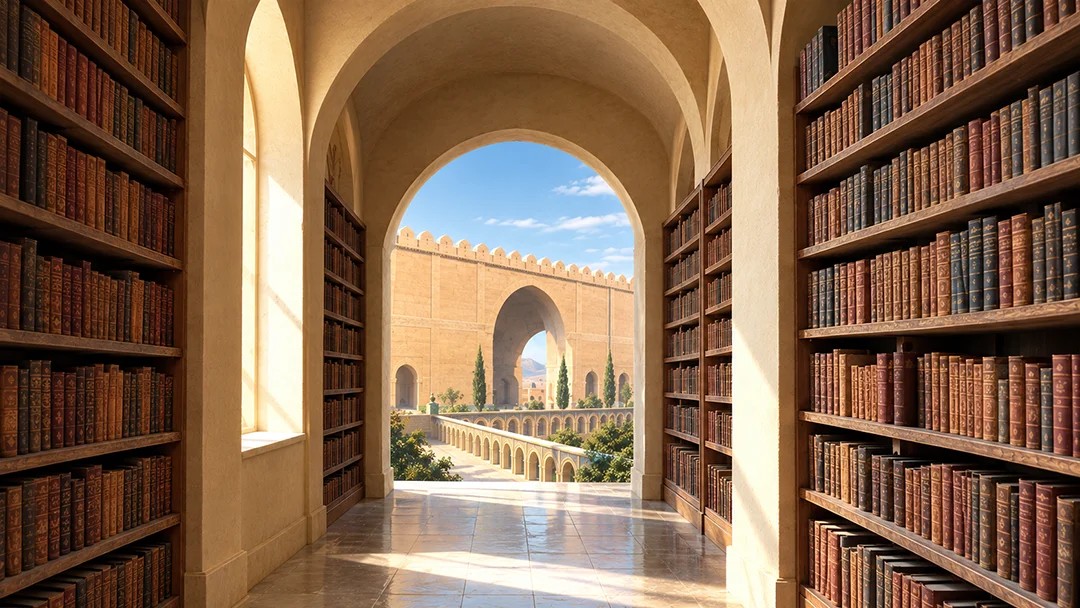
The Library of Rishahr (Riv-Ardashir)
One noteworthy reference in post-antiquity (the post-Islamic period) sources concerns the Library of Rishahr. Rishahr was located near present-day Bushehr.
According to Yaqut al-Hamawi's Mu'jam al-Buldan, this region was associated with the production of books on medicine, astronomy, and philosophy.
Yaqut writes:
It was a district within the province of Arrajan where, during Persian rule, there lived a group of scribes known as Kasht-e Daftaran. They were the writers of the Jastag script, which was used for writing books on medicine, the stars, and philosophy.
(Yaqut al-Hamawi, Mu'jam al-Buldan, Vol. 3, p. 112)
Little is known about the Jastag script (Kitabat al-Jastag) mentioned by Yaqut. It remains unclear whether the term referred to a particular writing system with distinctive linguistic and graphic characteristics or to a specific form of calligraphy.
What can be inferred from this account is that scribes in the region produced scholarly writings on medicine, astronomy, and philosophy.
The Saruyeh Library
One remarkable event recorded in post-antiquity sources was the unexpected discovery of books belonging to an ancient library known as Saruyeh. Historians such as Abu Rayhan al-Biruni, Hamza al-Isfahani, Ibn al-Nadim, and others explicitly refer to this discovery (al-Biruni, 2010, p. 35; Hamza al-Isfahani, 1967, pp. 182, 184, and 438; Ibn al-Nadim, 2003, p. 438).
The structure appears to have served as a repository for preserving books against the passage of time and various forms of damage. Its origins may possibly date back to the Achaemenid period.
Based on the accounts preserved in historical sources, several conclusions can be drawn:
1. The discovery of manuscripts on two occasions: Manuscripts were reportedly discovered in the Saruyeh Library twice: once in antiquity, possibly during the Parthian period, and again in 350 AH (961–962 CE). This suggests that a considerable number of manuscripts had been stored there.
2. The use of an ancient writing system: Many of the documents were written in a very ancient script that was unknown in 350 AH. They were therefore not written in Sasanian Middle Persian (Pahlavi), since that script was known at the time. Historical accounts describe the writings as being in Old Persian. It is possible that they were written in scripts and languages used during the Achaemenid period.
3. Preserved copies rather than original manuscripts: These manuscripts were apparently not the original versions of the books but copies made to ensure that their contents would survive for future generations if the originals were destroyed.
4. A repository designed to protect knowledge: The library appears to have been established to prevent the destruction of knowledge as a result of natural disasters. It is therefore possible that other major libraries once existed in Iran but were destroyed during invasions and periods of foreign domination. Some parts of this cultural heritage survived because they had been protected against natural disasters and human destruction.
5. The fate of the earlier manuscripts: Today, no trace remains of the older manuscripts discovered approximately a thousand years before Hamza al-Isfahani's time. What happened to them? According to Abu Ma'shar, at least some had already been translated into more recent languages in antiquity. Were those manuscripts or their translations preserved in major libraries such as those of Istakhr, Ctesiphon, or the Academy of Gondishapur? If so, historical accounts leave open the possibility that they were lost during the Arab invasions.
Furthermore, no trace remains of the fifty manuscripts reportedly discovered in 350 AH. Since nobody at the time could read them, it appears that the rulers of that era, the Abbasids, made no substantial effort to preserve them.
The Ganǰ-e Šāygān (Royal Treasury of Knowledge)
One of the important collections of books during the Sasanian period was known as the Ganǰ-e Šāygān.
According to ancient sources, Ardashir I, the founder of the Sasanian Empire, and Shapur I collected numerous books on various scientific and religious subjects from territories such as India, China, and Rome (Denkard IV, p. 64; Ibn al-Nadim, 2002, p. 347). According to the Denkard, these books were examined and compared with the Avesta, and the results of this process were placed in the Ganǰ-e Šāygān (ibid.).
This undertaking appears to have had religious objectives, and many of the collected works were probably religious and Zoroastrian in nature. Nevertheless, the collection also included writings on astronomy, medicine, crafts, technical skills, and other subjects, which were likewise examined in relation to the Avesta.
The Denkard provides the following account of the Ganǰ-e Šāygān:
Ardashir, King of Kings, son of Papak, acting with truth and confidence in Tansar [the renowned Zoroastrian priest], summoned all the scattered teachings to his court. Tansar came and accepted those that were consistent, while rejecting those that differed. This, too, was one of Ardashir's instructions to us: that every commentary concerning the religion, whether already existing or not yet available, should be collected.
Shapur, King of Kings, son of Ardashir, also collected religious writings concerning medicine, discussions of astronomy, and investigations into the nature of time and space, the philosophical essence of creation, generation and corruption, change and transformation (including the principle that nothing in nature is ultimately destroyed but merely transformed), rhetoric, eloquence, and other crafts and skills that were scattered throughout India, Rome, and other lands. He compared them with the Avesta and ordered that a copy of whatever was found to be consistent with it be deposited in the Ganǰ-e Šāygān, so that all those who were not righteous might be invited to reflect upon the Mazdayasnian religion.
(Denkard IV, p. 64)
Collections of Historical, Romantic, and Poetic Writings
Hamza al-Isfahani, in his book Al-Amthal al-Sa'ira min Buyut al-Shi'r, provides a noteworthy account of repositories of wisdom and knowledge in ancient Iran, which, in modern terminology, could be regarded as valuable libraries.
Hamza al-Isfahani writes:
As for the Persians, their prose accounts of historical events and wars, as well as the scattered narratives of their lovers and romantic tales, were transformed into poetry for their kings. These poems were recorded within books and preserved for eternity in repositories known as houses of wisdom. So vast was the resulting collection that its contents could scarcely be counted. However, most of it disappeared with the fall of their kingdom. More than ten thousand written sheets in their Persian script nevertheless survived.
(Hamza al-Isfahani, 2009, p. 64)
This account may refer to the Khwaday-Namag (Book of Kings) and other historical works of ancient Iran. Musical and metrical compositions such as Andarznameh-ye Behzad Farrokh-Piruz and Khaym o Kherad-e Farrokh-Mard are also noteworthy.
Together with Hamza al-Isfahani's account, these works demonstrate that ancient Iranian literature encompassed a wide range of subjects and was not limited to religious texts. Nevertheless, a substantial part of this written heritage gradually disappeared over time.
Translation of Scholarly Works from Other Civilizations
As mentioned earlier, during the reigns of Ardashir I and Shapur I, various books from India, China, and Rome were collected. However, the Sasanian ruler most widely associated with the collection and translation of foreign works was Khosrow I Anushirvan.
According to Ibn al-Nadim in Al-Fihrist, Anushirvan had a profound interest in science and scholarship and devoted himself to collecting and compiling books (Ibn al-Nadim, 2002, p. 347). The translation movement that later became famous under the Abbasid caliphs was, to a considerable extent, modelled on earlier Sasanian initiatives, particularly those undertaken during Anushirvan's reign.
Borzuya the Physician translated the Indian work Panchatantra, which later became known as Kalila wa Dimna.
Bozorgmehr also interpreted astronomical writings from other civilizations. One example is the book Wazidag (Selections), which was translated during the Islamic period and became known as Al-Bazidaj. Its author was Valens, and Bozorgmehr provided an interpretation of the work (see Tafażżoli, 2010, p. 185).
Paul the Persian wrote a remarkable introduction to Aristotle's logic. This is the treatise on Aristotelian logic addressed to King Khosrow, a Syriac manuscript of which is preserved in the British Museum. Miskawayh also refers, in his book Tartib al-Sa'adat, to a work by Paul that served as a general introduction to Aristotelian philosophy.
Schools, Academies, and Educational Institutions
According to Middle Persian texts, scribes received their education in specialised schools known as Dabirestans, where they studied under the supervision of teachers. Princes and the children of the nobility also attended these institutions.
In addition, large groups of artisans, merchants, craftsmen, and farmers were part of society, and literacy was necessary for their everyday activities.
Middle Persian literature also mentions an institution known as a Farhangestan, which appears to have been an ordinary school where general subjects were taught. Teachers working at these schools were known as Farhangbeds (see Tarikh-e Jame', Vol. 4, pp. 309–310).
Beyond the political boundaries of the Sasanian Empire, written works and educational institutions also existed throughout the broader Iranian cultural world, including Central Asia. Iranian culture maintained a significant presence in these regions, independently of their political structures.
Numerous written documents have been discovered from ancient Sogdiana, containing religious, artistic, and epic material. However, following the invasions by the caliphal armies, a substantial part of this cultural heritage gradually fell into oblivion. Archaeological discoveries in recent centuries have considerably expanded our understanding of ancient Sogdian culture.
In ancient Khwarazm, educational institutions existed for teaching the Khwarazmian language and history. However, the armies of the caliphs dealt harshly with these centres and their custodians.
Abu Rayhan al-Biruni writes in Al-Athar al-Baqiya:
Qutayba ibn Muslim [the commander of the caliph's army] put to the sword everyone who knew the Khwarazmian script. He also eliminated those who were familiar with the history of the Khwarazmians and taught these accounts and information among themselves. As a result, the history of Khwarazm became so obscured that it can no longer be known after the advent of Islam.
(Al-Biruni, 2010, p. 57)
The Academy of Gondishapur
The Academy of Gondishapur was one of the major centres of learning during the Sasanian period and an important intellectual institution in the wider world. Astronomy and medicine were among the subjects taught there.
Throughout Iranian history, including antiquity, physicians enjoyed a distinguished social position. Cyril Elgood, the renowned physician and Orientalist, considered the respected status and professional standing enjoyed by physicians in the modern world to be due, to a considerable extent, to the contributions of the Iranians.
The hospital at Gondishapur also served as a model for the construction of hospitals in other regions. Harun al-Rashid, the Abbasid caliph, reportedly ordered the construction of a hospital in Baghdad modelled on the Gondishapur institution.
Other Libraries
Scattered accounts in ancient sources provide indications of the existence of books and libraries in various Iranian cities.
A well-known tradition maintains that the Book of Zoroaster, or the ancient Avesta, was written on twelve thousand animal skins and preserved in Istakhr. For this reason, the Library of Istakhr is mentioned as one of the repositories where the ancient Avesta was kept.
Ibn Khaldun, the renowned Arab Muslim historian, also discusses the alleged destruction of books by the forces of Umar ibn al-Khattab following the conquest of Iran. His account may refer to a library in the Sasanian capital, namely the Library of Ctesiphon.
In his Muqaddimah, Ibn Khaldun writes:
When the land of Persia was conquered by the Arabs, they found numerous books there. Sa'd ibn Abi Waqqas wrote to Umar ibn al-Khattab, asking permission concerning these books and how they might be distributed among the Muslims as spoils of war. Umar replied that they should be thrown into the water, for if they contained guidance and truth, God had already guided us to something better than them; and if they contained the writings of misguided people, the Book of God was sufficient for us. Thus, they were thrown into water or fire, and the rational sciences of the Persians were lost.
(Ibn Khaldun, 1982, Vol. 2, p. 1010)
Religious Books and Writings
Any discussion of the books of ancient Iran would be incomplete without considering religious literature and written traditions.
Important works include the Avesta, Mino-ye Kherad (The Spirit of Wisdom), Shayest-Nashayest, Arda Viraf Nameh, Bundahishn, and many others.
Numerous religious writings also possess considerable literary significance and deserve attention for their influence on subsequent literary traditions. For example, the Andarznameh of Azarbad Mahraspandan had a notable influence on Persian literature and, following the advent of Islam, on Arabic literature as well.
The Gathas (Gathas or Gāhān) are among the oldest Iranian compositions. According to many Avestan scholars and researchers, these hymns were composed by Zoroaster, the ancient Iranian prophet. Linguistically, this section of the Avesta is among its oldest parts. It also possesses remarkable poetic qualities that distinguish it from other sections of the Avesta. This poetic character remains perceptible even in modern Persian translations.
It must be acknowledged that the Gathas occupy an exceptionally distinguished and substantial place among the ancient texts of Iran.
A comprehensive list of all the religious books of ancient Iran would be extensive, and discussing every one of them falls beyond the scope of this article.
Conclusion
What has been presented here represents only a small part of the written and cultural heritage of ancient Iran. Historical and literary writings, alongside scientific and religious works, all demonstrate the importance of books, knowledge, and culture in ancient Iranian society.
Although a considerable portion of this heritage has disappeared over the centuries or has not survived to the present day, the remaining works and accounts preserved in ancient sources continue to testify to a long-standing Iranian tradition of writing, collecting, and preserving knowledge in repositories and libraries.